
An ALS diagnosis changes everything — including how communication happens and who is responsible for facilitating it. The disease progresses differently for everyone, but speech is affected for most people with ALS at some point in their journey. The good news is that AAC technology has advanced dramatically, and eye gaze communication — which requires no hand or body movement — means that communication can continue long after mobility is significantly reduced. This guide is for families navigating this transition.
Start Earlier Than You Think You Need To
This is the single most important piece of advice from both clinicians and people living with ALS: start exploring AAC before it feels necessary. Learning a new communication system takes time — building vocabulary, practicing navigation, getting comfortable with the technology. If you wait until speech is severely impaired, the learning curve is much steeper. Many people with ALS find it helpful to begin with AAC as a supplement to speech, using it in situations where speech is tiring, and expanding its role over time.
Eye Gaze Is Often the Right Long-Term Solution
Early in an ALS diagnosis, many people use a combination of speech, low-tech AAC (letter boards, yes/no communication), and switch-access devices. But as the disease progresses and limb mobility decreases, eye gaze becomes the primary access method for many. EyeOn Air uses proprietary eye gaze technology that continues to work accurately even as eye muscle function changes — a critical feature for people with ALS.
What to Ask Your Neurologist and SLP
At your next appointment, consider asking the following:
- Has a speech-language pathologist evaluated my current and projected communication needs?
- What is the timeline for considering an AAC evaluation?
- How do we document medical necessity for insurance purposes?
- What AAC options are covered under my insurance or Medicare?
- What happens to my AAC access if I am hospitalized?
Building a Vocabulary That Reflects You
AAC is most powerful when it sounds like the person using it. In the early stages of ALS, when speech is still present, many people work with their SLP to record their own voice for use in their AAC device — a process sometimes called voice banking. Even if full voice banking is not possible, vocabulary systems can be customized to reflect a person’s communication style, sense of humor, areas of expertise, and relationships. This is your voice. It should sound like you.
For Family Members and Caregivers
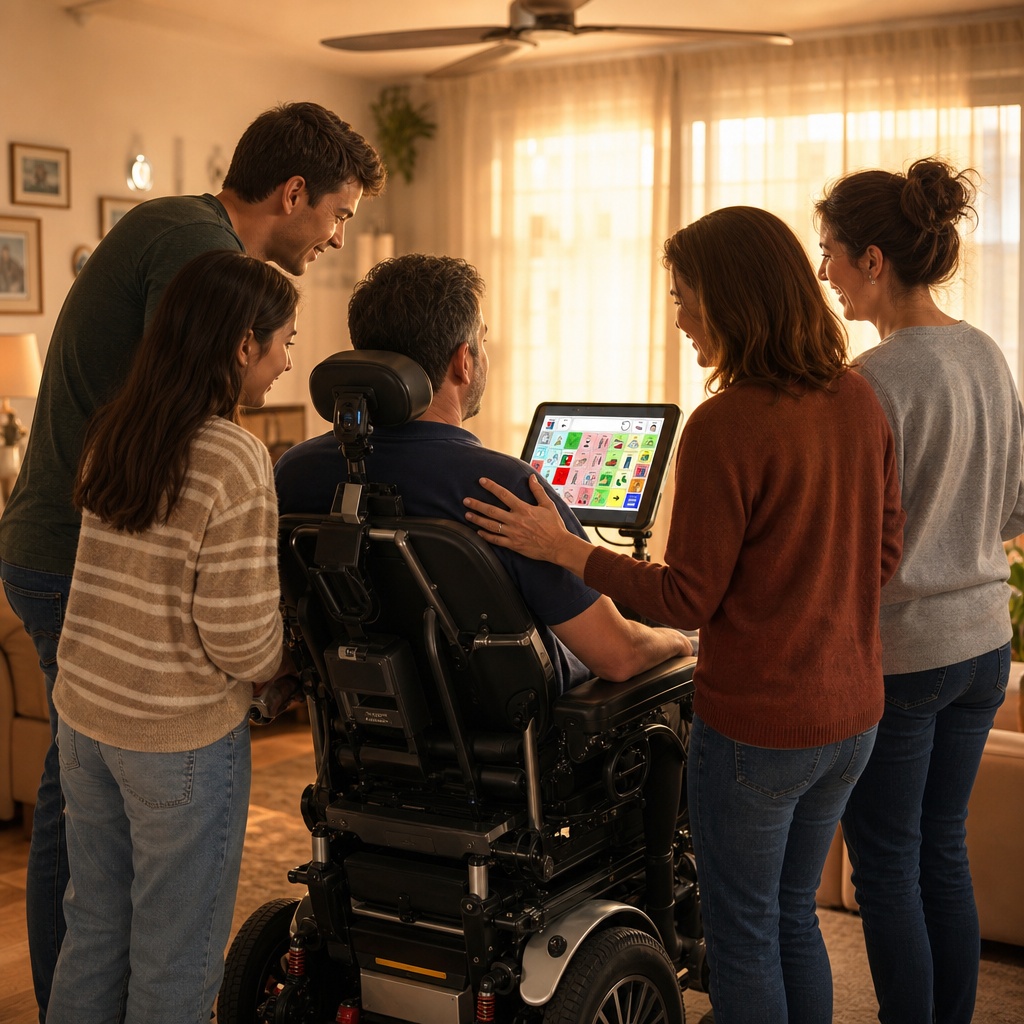
Caring for someone with ALS who uses AAC requires patience and a willingness to learn. A few things that help: give extra time for responses — AAC takes longer than speech, and rushing creates pressure. Learn the device alongside your loved one — you should be able to navigate it almost as well as they can. And listen to what they say, not just how they say it. The message matters more than the medium.
EyeTech’s Support for ALS Families
We have supported hundreds of families navigating ALS and AAC. Our team includes people who understand the clinical, emotional, and logistical realities of this journey. If you are newly diagnosed or supporting someone who is, reach out. We offer consultations, device trials, and dedicated support throughout the process.
Leave a Reply